
‘Nightbane’ by Alex Aster: The Most Disappointing YA Fantasy Sequel
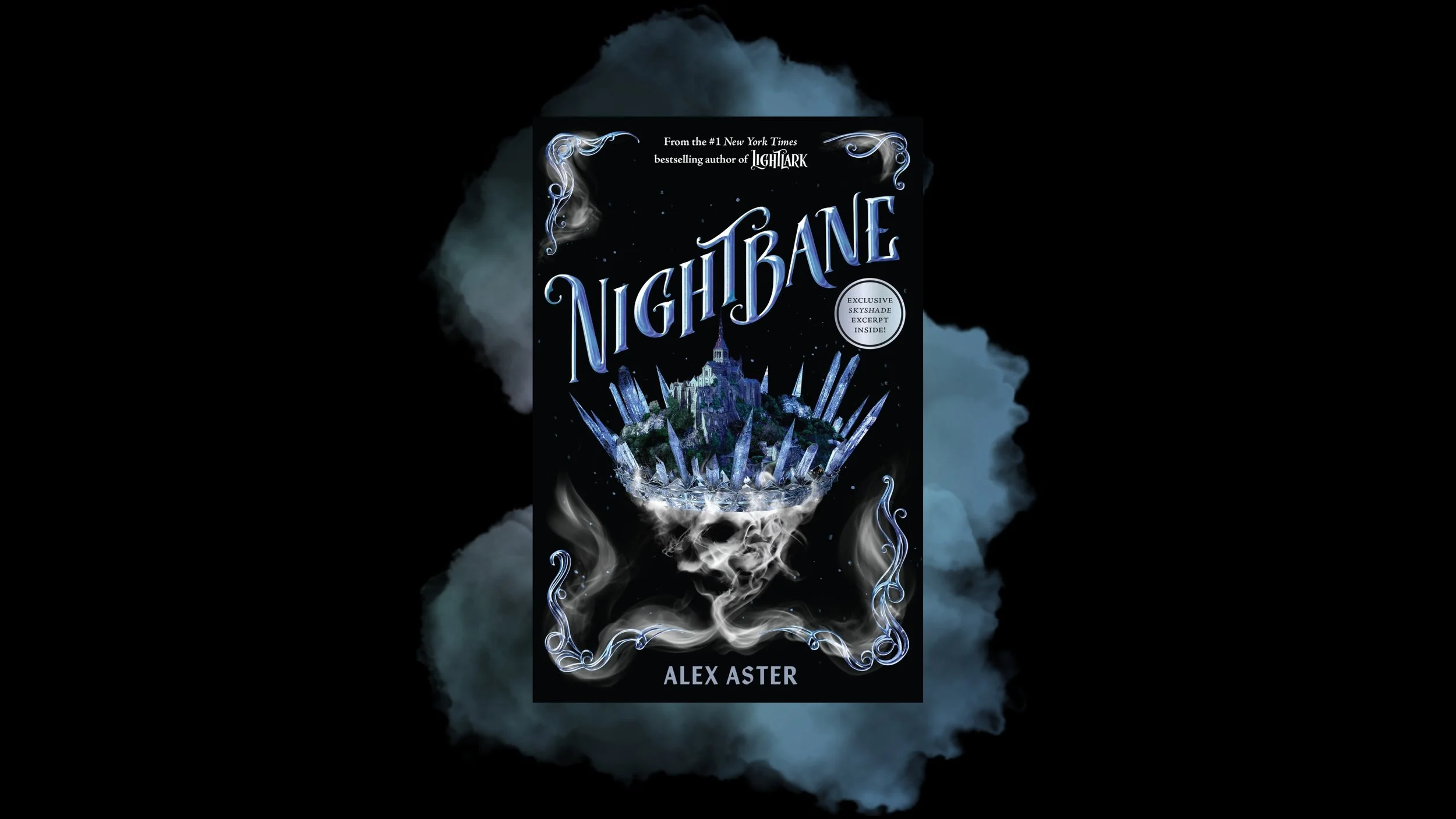
Alex Aster, New York Times Bestselling Author of young adult fantasy is most well-known for The Lightlark Saga. I finished Lightlark (the first book of the series) ages ago, and had been looking forward to continuing the story for a long time. I rated Lightlark a perfect five stars when I read it in 2024 and remember being enthralled by the characters, the world, and the love triangle between the main characters. When reading or watching anything, I am usually the type to lean very heavily towards one side, completely ruling out the other pairing in any triangle. However, throughout the first volume, I was torn and found myself constantly switching who I was rooting for. Aster’s ability to create that conflict within a reader, especially one who isn’t usually indecisive in this sort of thing, is commendable. The idea behind Lightlark, a Hunger Games inspired gathering amongst the rulers of six realms who compete to break the curses put on them, is captivating, and Aster’s portrayal of this idea was well executed and kept me turning each page.
That being said, I was anxious to read more and had high hopes for the continuation of the series. I finally got to picking up Nightbane and I unfortunately almost put it down many times. Perhaps it’s been too long since I’ve read Lightlark and since I’ve read so many incredible fantasy novels in between finishing Lightlark and picking up Nightbane, if I went back and re-read the first volume again, I would be more attuned to the same mistakes Aster made in the sequel. Or maybe Nightbane was simply rushed after the success of her Young Adult Fantasy debut. Regardless, Nightbane felt cliché and derivative of other popular fantasy series such as Sarah J. Maas’ A Court of Thorns and Roses. Overall, Nightbane was the worst fantasy sequel I’ve possibly ever read.
The main character Isla is the young ruler of the Wildling realm. Raised in confinement, she has no experience or true understanding of battle or politics. She also is ignorant towards her own realm, knowing nothing about her people or the issues her realm faces. Book one ends in Isla winning the centennial (the competition the rulers enter to break their curses) and King Oro, one of her love interests, saving her life. While breaking the curses, Isla absorbs the powers of the Starling ruler Aurora, making her the new ruler of the Starlings.
With zero knowledge of how to rule her own realm, it is astonishing to think Isla could be capable of ruling two. She knows as little about Starling as she does about Wildling, and is painfully aware of this fact. Throughout Nightbane, Isla is full of self doubt that makes readers physically roll their eyes. Anyone can tell she is incapable of ruling or fighting in battle due to her lack of knowledge and experience. At the beginning of book two, Isla can barely control her magic, but by the end of the book, readers are expected to believe she is more powerful and can defeat rulers that have been alive and practicing their craft for hundreds of years. It makes the story unbelievable and adds to the intolerableness of the main character.
Isla convinces the Vinderlands (a bloodthirsty subset of Wildings) and other magical creatures to fight alongside her against Grim and his Nightshade realm. Neither are inclined to fight before, but both are easily convinced to join her despite Isla’s lack of knowledge on politics and war. By the end of Nightbane, Isla rides into battle on Lynx, a gigantic black leopard that once belonged to her mother. She successfully traps Cleo (ruler of the Moonlings) in vines and kills dozens of Nightshade warriors in one go from her newly found powers. In fantasy, most things are meant to be unbelievable since the worlds, magic, and creatures are often completely made-up. However, this is a totally different type of unrealistic. I don’t believe any of it.
Most of the storyline in general is extremely far-fetched that I physically cringed more than once. Oro, one of the main love interests, has ruled Lightlark for over five hundred years, yet he is quick to put a girl he just met over his duties, and brush away her treason because he loves her. Isla is accused of treason after summoning Grim, their enemy and Isla’s other love interest, to King Oro’s castle.
“Zed’s look was incredulous. ‘That… that’s treason,’ he said. ‘You summoned our enemy to the Mainland castle. The person who is hell-bent on destroying all of us.’ He looked to Oro whose expression had hardened. ‘Let her speak,’ he said.” (Aster, 334).
Isla’s naivety is just as evident here as the rest of the series thus far. But Oro’s lack of care is another story. No ruler can reign as long as he has if he is truly that naive and soft. Nothing comes of her treason, and Oro continues to coddle her. The next time it is discussed, Isla expresses her self-doubt to Oro in the most, for lack of a better term, “pick me” type of way.
“She looked at him, incredulous. He should hate her. His endless patience and forgiveness was infuriating, because it couldn’t possibly be real. Enya was right. Oro deserved better than her. She wasn’t good for him. ‘I’m broken, Oro,’ she said. ‘You should really—you should really find someone else to love.’... His gaze did not falter. ‘I have waited hundreds of years for you,’ he said. ‘You have no idea how patient I can be.’ Tears burned in her eyes as she looked at him. ‘I don’t deserve your love.’” (Aster, 358-359).
It’s not an unpopular opinion amongst the fandom that Aster intends to turn Oro into a character like Tamlin, from Mass’ A Court of Thorns and Roses, which was released seven years prior to Lightlark. Aside from the memories taken away from Isla, we see her with Oro first, and are expected to believe that Grim, ruler of a different realm, with his shadow powers and “love bond” with Isla (that she doesn’t fully understand yet), is the bad guy. When in reality, she’s probably going to end up with him after realizing some truth about his pure intentions and Oro’s potential lack of them. Sound familiar? This love triangle is a cheap rip-off of Feyre, Rhysand, and Tamlin. However, if we are intended to root for Grim over Oro, Aster has done a poor job at convincing readers to dislike Oro. Aside from his unbelievable willingness to put Isla above the entire realm, he has done nothing wrong thus far.
Despite Isla having two love interests, I find her having no chemistry with either of them in Nightbane. A large part of this is likely due to the fact that I find her character insufferable and pathetic. Her and Oro seem to have been thrown together without any pining or buildup. Isla and Grim had a relationship in the past, which readers are introduced to slowly through flashbacks of memories Isla is rediscovering. Grim is described as dark, powerful, and terrifying. I love a dark character who is soft for only their love interest, and it is done so well in many popular fantasy series such as Mass’ Rhysand (A Court of Thorns and Roses) and Yarros’ Xaden (Fourth Wing). However, the execution of this balance with Grim is underwhelming. Whenever he and Isla were together, I found it boring and his character inconsistent.
Fans of the Netflix television show Bridgerton went crazy when Anthony Bridgerton confessed, “You are the bane of my existence and the object of all my desires," to Kate Sharma in Season 2, Episode 5, which aired in early 2022. Nightbane’s release in late 2023 utilized a similar line early in the book, which was awkward enough. The line is repeated in a later speech from Grim.
“‘You were once the bane of my existence… and now, you are the center of it.’ He couldn’t possibly be saying this, not him, demon in the shadows, ruler of darkness. Not him, looking at her as if she was the answer to all his dreams… ‘What I feel for you can never be extinguished. Like the nighttime sky, it is infinite. You and me… we’re infinite.’” (Aster, 386).
The exact quote is repeated on the very next page—“‘Oh Hearteater,’ he said. You and me… we’re infinite.’” (Aster, 387). And again less than ten pages later. I wish I kept a tally of how many times I rolled my eyes during this read.
The entirety of Isla and Grim’s relationship is made up of poorly written confessions, all competing to be the most discomfiting.
“‘To pretend I don’t know that you love chocolate, and touching your hair, and that you blush when I look at you for more than a few seconds. Or that you hate the cold and love to dance and you frown when you lie.’ His words were so soft. So unlike him. He tucked her hair behind her ear. ‘You really do, by the way,’ he said. ‘You should work on that before the Centennial.’ She blushed, because he had been looking at her for more than a few seconds,” (Aster, 348).
By the way, if everything he says is soft, constantly saying that is “unlike him” really loses its effect.
“‘Grim… what—what is wrong with me?’ He took her face in both his hands. ‘Nothing, absolutely nothing is wrong with you, heart.’ He said it for the second time, and it directly contradicted everything she had ever thought about herself. She went on her toes and kissed him. It was clumsy and too forceful and caught him by surprise. She fell on her heels, wondering why in the world she’d done that, but she didn’t wonder for long.” (Aster, 350).
“Grim swallowed. ‘I’m not gentle,’ he said gruffly. Isla opened her mouth. Closed it. The thought of him not being gentle… it unexplainably made her feel hot everywhere. ‘Could—could you be?’ He hesitated. Then nodded.” (Aster, 351).
Every interaction between them gave me secondhand embarrassment. Which is such a pity, because I was so intrigued by the entire love triangle throughout the first book. The characters and their relationships significantly lost appeal throughout the sequel.
Aster also does a poor job with descriptions. Everything was directly told to readers rather than shown. This made Nightbane seem flat and uninteresting, with no room for readers to connect with the characters on an emotional level.
Overall, I am regrettably disappointed in Nightbane, especially after enjoying Lightlark as much as I did. Upon finishing the book, I found myself glad it was over and I could move onto a different book rather than being excited for the third volume in the saga, Skyshade. While the idea behind The Lightlark Saga is extremely compelling and Aster does a fantastic job at writing a conflicting love triangle, I do not find myself anxious to continue this story or find out who Isla ends up with.
