
Figure and Space in Southern France
Different cities around the world have idiosyncratic effects on those who visit them, as each area is made up of its own culture and architecture. During the nineteenth century, France was societally split in two, dividing the north from the south. The Art Bulletin’s Anne Dymond states, “Generally speaking, those who favored industrialization applauded the modernization evident in the north, while conservatives championed the supposedly happier and healthier ‘traditional’ culture of the south… Interpretations of southern culture by the writers Stendhal and Maupassant (both favorites of [Paul] Signac), and the anarchist geographers Reclus and Kropotkin as well, inventoried differences between north and south; more importantly, however, their accounts accentuated the perceived freedom of life in the south and, in the case of Reclus, highlighted the region’s special role in a peaceful future. These constructions of the south as freer and more harmonious would have been particularly attractive to Signac and his Neo-Impressionist colleagues,” (Dymond 2003, 355). Paul Signac, a prominent Neo-Impressionist painter spent many years in the south of France and held deep anarcho-communist views throughout his lifetime. Anarcho-communism endorses the rejection of the State in favor of societies satisfying their own needs. Signac’s art was a vessel through which these political views shone through.
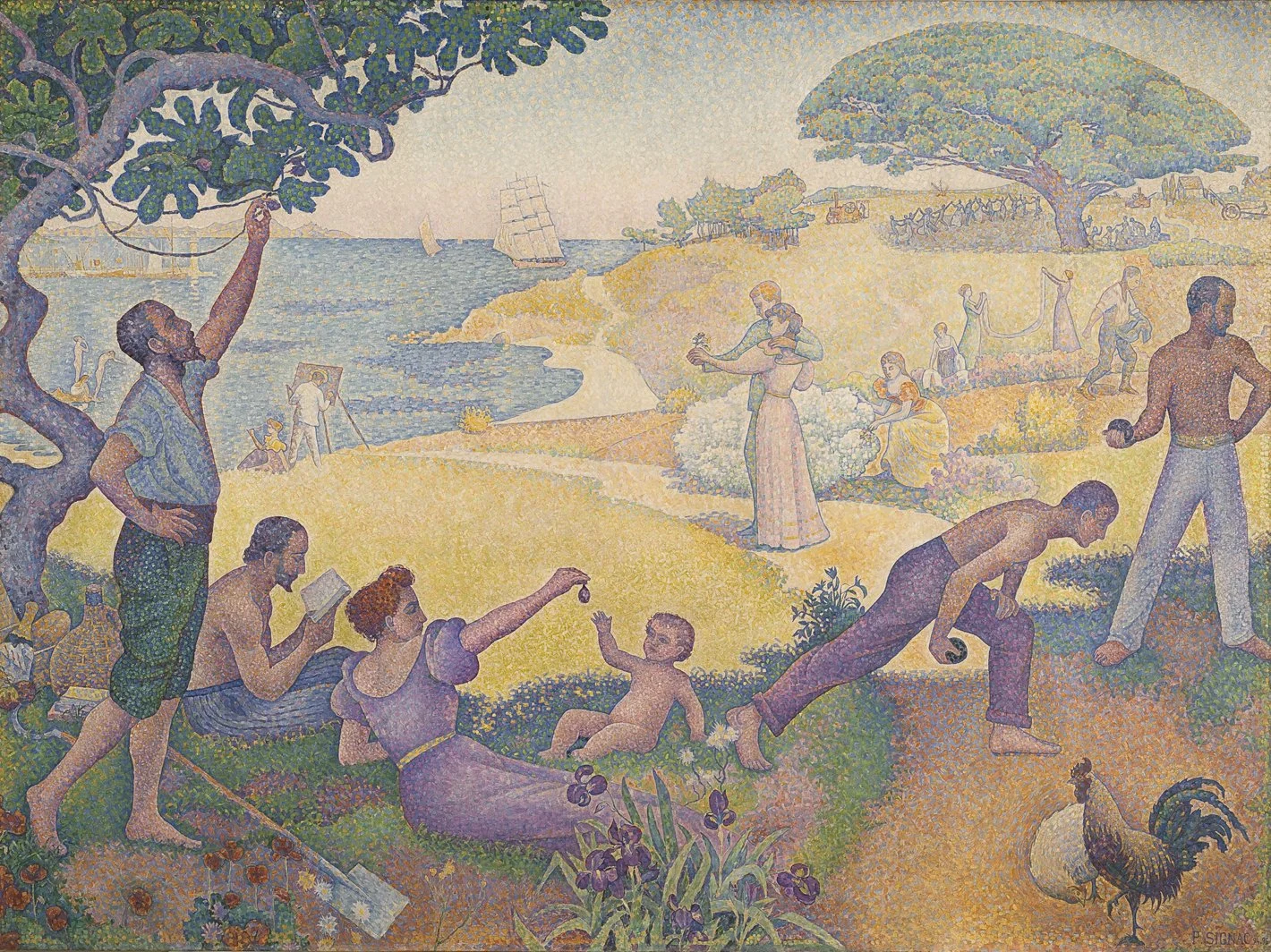
Signac’s belief in anarchy was particularly evident in his Pointillist piece, In the Time of Harmony: The Golden Age Is Not in The Past, It Is in The Future. Originally titled In the Time of Anarchy, this painting depicts a utopian society free from capitalist exploitation where leisure and work coexist harmoniously. Signac spoke about this painting, stating, “When the society that we dream of exists, when rid of the exploiters who exhaust him, the worker will have time to think and to learn.” Signac believed that true intellectual freedom, depicted here in southern France, could only be accomplished when individuals were not burdened by an overexhausting economy. His view of southern France during this time remains similar to Provençal life today, especially in comparison to the more modern and industrialized north. The south of France is Mediterranean and is often associated with beach towns on the Côte d'Azur. The ocean and lavender fields are two of the many factors that contribute to the more relaxed and slow-paced lifestyle in Provence. Opposingly, the north was home to heavy manufacturing and a massive working class.
Harmony features a variety of subjects ranging from embracing lovers to boules players to a tractor, to name a few. The tractor “relieves much human labor, allowing for the leisurely life depicted elsewhere in the painting; it invokes the anarchist belief that modern machinery would improve the lot of humanity,” (Dymond 2003, 361). Due to this alleviation, individuals are granted more time for their intellectual activities, improving their overall wellbeing and intelligence. Their relaxed stances in the painting contribute to Signac’s belief in anarchy, or a peaceful society without negative government interference.
Having spent the past four weeks in the South of France, I have already found myself more relaxed and eager to devote time to cognitive pursuits compared to the lifestyle I keep back home in cities such as Atlanta, Georgia and Orlando, Florida. The limestone buildings, cobblestone pathways, and mountainous views that surround me in Provence have given me a sense of peace and time has finally seemed to slow down. My anxieties stemming from sensory overload, the lack of nature, and looming career deadlines in larger cities have been replaced with a greater awareness for self-care, healthier daily routines, and an overarching want to invest time in intellectual endeavors such as reading, writing, journaling, and immersing myself in a new language.
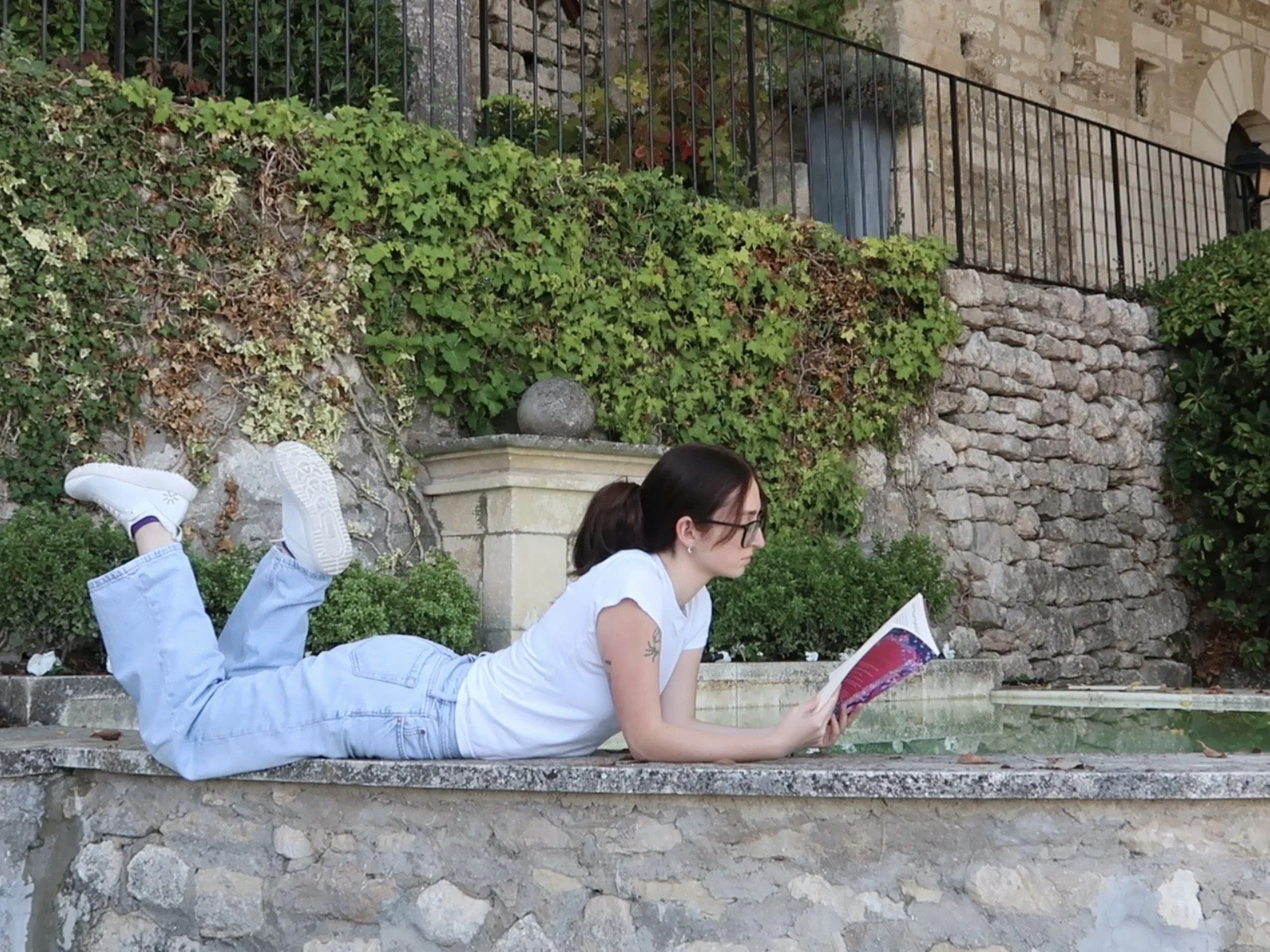
Reading in particular has proved to be a prominent pastime for me in Provence. No matter where you step foot here, you are met with majestic views of mountain ranges, lavender fields, medieval ruins, and cypress trees. Spending time in nature is known to reduce stress. Mixed with the beautiful architecture of the buildings and fountains in southern France which provide endless artistic inspiration, Provence truly invokes strong feelings of freedom and harmony in anyone who visits.
I photographed myself lounging on the edge of a fountain located on my favorite terrace to further analyze the connection between figure and space and the connection between one’s environment and their behavior. From terraces, one is privy to landscapes in all directions. “A terrace leads onto the tiled roofs of the buildings below and offers view onto further multiple levels,” (Scott Budzynski 2023, 44). This creates an interest for those spending time on these terraces, but also a visual interest within photographs or other artworks. Within my photograph, multiple levels are evident which allowed me to play with space and utilize the rule of thirds. Between the architecture of the buildings and fountain and the nature overpowering the limestone, a tranquil environment is incontrovertible, encouraging me to lounge naturally as opposed to how I might read in a different environment—sitting up straight with my legs crossed. This Provençal environment inspires me to loll about in the same way Signac’s subjects were placed in Harmony. Moreover, the environment in the South of France inspires individuals to devote time to activities such as reading, painting, and playing games, further connecting my photograph to Signac’s pointillist piece.
The behavior and position of any individual is indicative of the environment they are surrounded by and the culture one experiences in any particular city has a direct effect on how they move and divide their time. Both Signac’s Harmony and the image I photographed depict a Provençal society focusing on harmony, nature, and intellectual pursuits. The relaxed positions of the figures surrounded by nature perfectly illustrate the idea of anarcho-communism that Signac believed in. While southern France is not a true utopia, the atmosphere undoubtedly creates a space for the society and its individuals to balance relaxation and leisure with their professional responsibilities.
Bibliography:
Bernier, Makayla. “Chapter 10 – Paul Signac.” Open Education Alberta. (2022).
Budzynski, Scott. “Rethinking Space in Marseille: Provence as Facilitating Environment.” Studio Architecture and Urbanism Magazine, no. 22 (February 2023): 42–49.
Dymond, Anne. “A Politicized Pastoral: Signac and the Cultural Geography of Mediterranean France.” Art Bulletin 85, no. 2 (2003): 353–70.
Roux, Jacques. “Anarchist Communism - An Introduction.” Libcom. (25 October 2006).
Signac, Paul. In the Time of Harmony (Au temps d'harmonie). 1893–1895. Oil on canvas. Mairie de Montreuil, Montreuil, France.
